
Projected vs Actual Release Date
The phrase "projected release date" is often used loosely, but Alabama's public ADOC definitions use the more precise term "Minimum Release Date." For a Chambers County person sentenced to state prison, that ADOC field is the earliest scheduled date the inmate can be released to probation or end of sentence. It is a computation field, not a promise that the person will walk out on that date.
The first decision is whether the person has been sentenced. A pretrial detainee at the county jail usually waits on bond, court settings, warrants, holds, or a transfer decision, not an ADOC sentence calculation. A sentenced ADOC inmate has a prison record that can include release computation fields while the person remains incarcerated. A released ADOC inmate may disappear from the public search because ADOC says historical data is not available online.
For a person held only at the Chambers County Detention Facility, the useful records are different: booking record, bond status, court order, sentence credit, hold or detainer, transfer record, and release date/time if release has already occurred. Do not apply ADOC good-time rules to an ordinary county jail bond-out. For a person sentenced from Chambers County to ADOC, use ADOC, the Chambers County Circuit Clerk, ABPP, and Alabama VNS together.
Find a Chambers County Release Date
The best first step is to identify whether the person is in county jail, ADOC state prison, federal custody, or ICE custody. A county jail release date is usually held by the jail and explained by the court record. A state-prison release date is calculated by ADOC and affected by sentence information sent from the sentencing county. A federal release date belongs in BOP, and an immigration custody question belongs with ICE when applicable.
- Start with the last known custody system: Chambers County jail, ADOC, BOP, ICE, or another agency.
- For a county jail detainee, check the county-linked inmate search if accessible, then call the Chambers County Detention Facility at (334) 864-4336 for custody and release status.
- Search the Chambers County court record through the Circuit Clerk or AlaCourt for bond, sentence, jail credit, transfer, probation, warrant, or disposition entries.
- For an ADOC state prisoner, search the ADOC inmate search by AIS number when known. ADOC says AIS takes precedence and is the quickest exact-match route.
- If AIS is unknown, search by first and last name, remembering that ADOC name searching is open-ended and displays only 50 matching records at one time.
- Open the correct ADOC result and read the Minimum Release Date, Jail Credit, Good Time Received, Good Time Revoked, Time Served, Total Term, sentence type, Parole Consideration Date, and Parole Status fields where shown.
- If the person has already been released from ADOC and no longer appears, shift to ADOC public records, Alabama VNS, ABPP, and the sentencing court rather than treating the missing result as proof of no record.
The main Chambers County released inmate search gives the broader path for released people who have dropped off a live roster.
ADOC Minimum Release Date
Angle O is the central Alabama release-date point. ADOC uses "Minimum Release Date" as the relevant public release-date computation field. ADOC defines it as the earliest scheduled date an inmate can be released to probation or end of sentence, and says the date can change if disciplinary action removes good time or if the circuit clerk sends new cases or sentence changes. For a Chambers County sentence, that ties the ADOC date back to the Chambers County Circuit Clerk's court and jail-credit records.
Source lead-in: Alabama Code section 15-22-26.2 is one of the official state sources that can affect when eligible ADOC inmates leave custody for supervision.
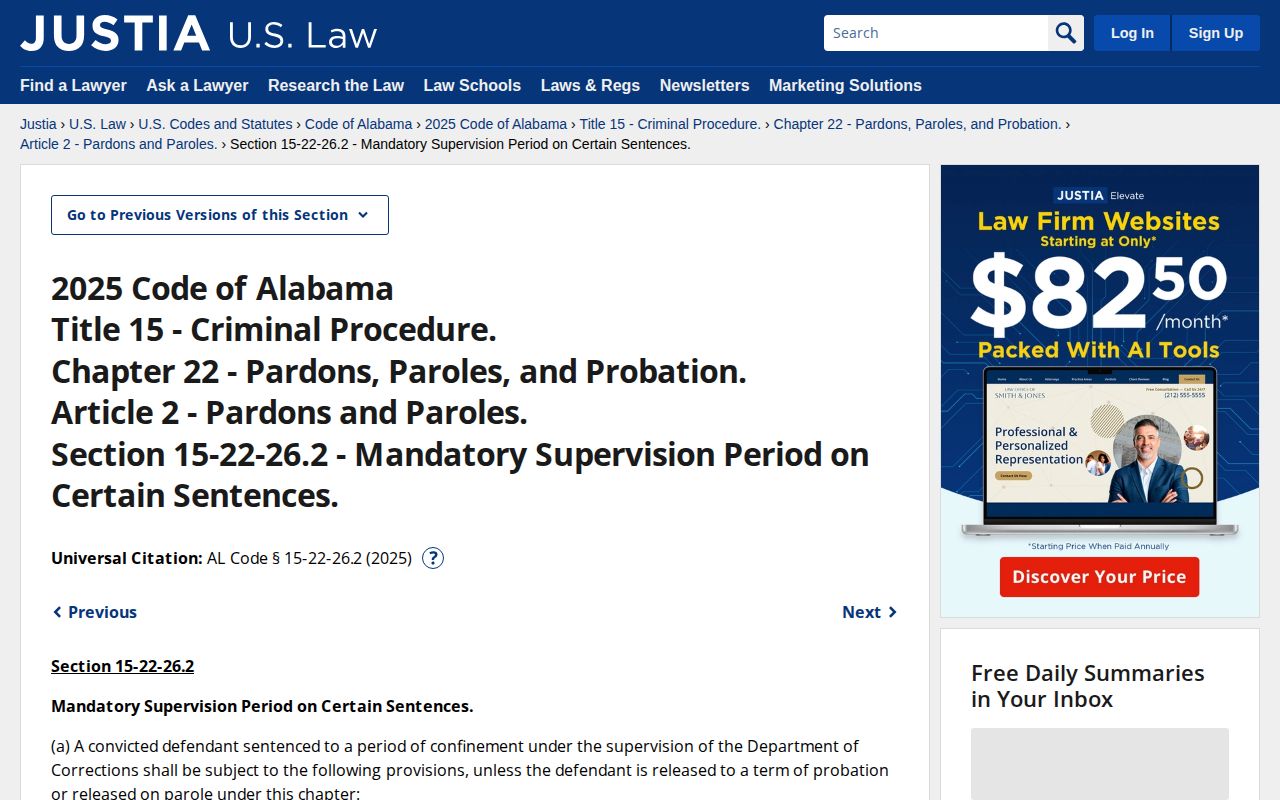
Use the statute together with ADOC definitions and ABPP information. A single date on a search page should be verified against the sentence, jail credit, court updates, and supervision route.
Good-Time Credit and Computation
Alabama's good-time framework is Correctional Incentive Time under Alabama Code section 14-9-41, administered by ADOC Administrative Regulation 425. The law and regulation should be read as a state-prison sentence-computation system, not as a universal county jail release formula. ADOC definitions identify Jail Credit, Good Time Received, Good Time Revoked, Time Served, Total Term, and concurrent or consecutive sentence type as fields that can affect the date.
Section 14-9-41 lists major exclusions from correctional incentive time. The research identifies exclusions including Class A felonies, life or death sentences, sentences over 15 years, specified death-causing crimes, and child sex offenses. Because eligibility depends on offense, sentence length, sentence structure, discipline, jail credit, and statutory exclusions, a Chambers County sentence cannot be reduced to a simple "everyone serves the same percentage" rule.
The 85-percent issue should be handled carefully. ABPP's FAQ says parole eligibility is calculated under Alabama Code section 15-22-28(e), and that sentence, crime, jail credit, good time, time served, and sentencing-court orders can affect the eligibility or set date. Some offenses have statutory minimum-service or eligibility rules, but those rules are not the same as a general county jail release date. Check the exact offense, sentence, and sentencing order.
Mandatory Supervision Near Sentence End
Alabama Code section 15-22-26.2 creates a mandatory supervision period for eligible ADOC inmates near the end of sentence. The research notes statutory windows tied to sentence length: for a sentence of five years or less, release to supervision occurs no less than three months and no more than five months before the release date; for more than five years but less than 10 years, no less than six months and no more than nine months; and for 10 years or more, no less than 10 months and no more than 12 months. The section excludes child sex offenses, requires victim notification before release, places eligible releasees under ABPP supervision, and permits electronic monitoring.
Mandatory supervision can make a release-date question look inconsistent if the reader expects the person to remain in prison until the exact end date. The person may leave ADOC custody for supervision and still have reporting duties through ABPP. That is a state-prison release path, so it should be verified through ADOC, Alabama VNS, ABPP, and the sentencing court rather than through the Chambers County jail roster.
ABPP's institutional parole services page describes mandatory release as an automated process under section 15-22-26.2 for inmates whose offenses occurred on or after January 30, 2016, excluding child sex offenders and life sentences. This is why someone may leave ADOC custody before the literal end of sentence but still remain under supervision. It is not the same thing as discretionary parole, and it is not how an ordinary Chambers County jail bond release is computed.
Why a Release Date Changes
Projected release dates are sensitive to new information. ADOC specifically says Minimum Release Date can change when disciplinary action takes away good time or when the circuit clerk sends new cases or changes to the current sentence. For Chambers County cases, court records and clerk updates matter because jail credit and sentence corrections can originate from the sentencing county.
| Change Factor | How It Can Affect the Date |
|---|---|
| Good Time Revoked | Disciplinary action can remove good time and push the Minimum Release Date later. |
| Good Time Received | Correctional Incentive Time can reduce eligible state-prison time, subject to exclusions and ADOC rules. |
| Jail Credit | Time spent in county jail before sentencing can count toward the sentence. ADOC says the sentencing county's circuit clerk prepares jail credit. |
| New cases or sentence changes | A new case, amended order, or sentence correction sent by the circuit clerk can change ADOC computation. |
| Concurrent or consecutive sentences | Sentence type affects total time because sentences may run together or one after another. |
| Parole decision | A parole grant, denial, continuance, or deferment affects discretionary release expectations but is not always same-day physical release. |
| Detainers or holds | Another agency hold can turn a local release into a transfer, or delay community release until the hold is resolved. |
| Mandatory supervision | Eligible ADOC inmates may leave custody for ABPP supervision within statutory windows before the release date. |
County Jail Dates Are Different
The Chambers County sources do not publish a county jail good-time policy, weekend-release rule, or confirmed online release-date field. The county detention page links to an inmate search, but the linked destination could not be inspected during research, and no confirmed 24-hour or 72-hour official release feed was found. Treat the county lookup as current-custody information unless a later official view proves it has a release archive.
For a county jail detainee, ask what controls release: bond posted, judge's order, time served, sentence completion, dismissal, transfer to ADOC, U.S. Marshals hold, ICE hold, or another agency pickup. A person who disappears from a current jail list may have been released, but may also have been transferred, booked under a variant name, sealed from public display, or affected by a site update. The durable proof usually comes from the jail release record and court docket.
If the question is the exact release time, ask the jail for the booking and release record rather than relying on a later online search. If the question is why release did not happen, check bond status, warrants, court orders, detainers, and receiving-agency transfer records. If the question is sentence credit, the Chambers County Circuit Clerk is relevant because ADOC definitions say the sentencing county's circuit clerk prepares jail credit.
Confirming a Release Date
Use alerts and records together. For a pending ADOC release, Alabama VNS may provide notification because it covers offenders convicted in Alabama and sentenced to ADOC custody. VINELink Alabama can also be checked for custody status and notification options, but county jail participation was not confirmed in the researched Chambers County sources. The VINELink check page explains how to search one person and register for release notifications.
If the person is still in ADOC custody, the ADOC inmate search is the public starting point. If the person has been released from ADOC, ADOC says historical data is not available online, so use ADOC public records, Alabama VNS, ABPP records, parole results, hearing minutes, and the sentencing court. If the person is in federal custody, use BOP. If the person may be in immigration custody, use ICE. If the release was from the Chambers County Detention Facility, call the jail and check the Chambers County court record for the order or disposition that explains the release.