
When Chambers County Cases Go to ADOC
No Alabama Department of Corrections prison facility was identified inside Chambers County in the ADOC facility directory. The ADOC release path is therefore a statewide sentence path, not a local Chambers County facility page. A person may be booked at the Chambers County Detention Facility, appear in Chambers County court, and later be sentenced to ADOC. At that point, the county jail may show a release or transfer from sheriff custody, but the person has not necessarily been released into the community.
This distinction prevents the most common records error. A county jail "release" to ADOC means the sheriff stopped holding the person. It does not prove freedom from custody. The next public source is ADOC while the person is incarcerated, followed by ADOC records, Alabama VNS, ABPP, and the sentencing court when the person leaves prison or moves to supervision.
The Chambers County court record remains important throughout the process. It can show the conviction, sentence date, sentence length, jail credit, split-sentence structure, probation terms, revocation history, or later order that affects custody. ADOC's calculations depend partly on court and clerk data, so a sentence change or newly transmitted case can alter the projected release information shown by ADOC.
How to Confirm an ADOC Release
The ADOC inmate search is essential for a Chambers County person who is still in state-prison custody, but ADOC states that the online database contains only currently incarcerated inmates and that historical data is not available online. If the person is no longer in the search, that may mean release, but it may also mean a name mismatch, Youthful Offender exclusion, non-ADOC sentence, out-of-state custody, or another data limitation.
- Search ADOC by AIS number if known. ADOC says the AIS number is the unique six-digit number assigned to an incarcerated person, and that AIS takes precedence over name fields.
- If AIS is unknown, search by first and last name. Be aware that partial last-name searches can return many records and ADOC limits displayed results to 50 matching records.
- If the person is found, record the institution, AIS, offense, sentence date, Minimum Release Date, Parole Consideration Date, Parole Status, Jail Credit, Good Time Received, Good Time Revoked, Time Served, Total Term, and sentence type.
- If the person is not found and the issue is a past state-prison release, use ADOC public records, Alabama VNS, ABPP parole or supervision sources, and Chambers County court records.
- If the county jail record shows only a transfer to ADOC, do not describe that as community release unless ADOC, ABPP, VNS, or court records later confirm release from state custody.
Alabama VNS is also state-prison specific. The official state VNS page says it is for offenders convicted in Alabama and sentenced to prison in ADOC custody. It is not presented as a universal Chambers County jail release feed. For not-yet-tried county cases, the VNS page directs users to the sheriff in the county where the crime occurred.
ADOC Records and Release Contacts
ADOC records are statewide. Use ADOC for state-prison custody and release records, not for routine county jail releases or short local sentences. If the public search no longer shows the person, request the state-prison release or discharge record through ADOC's public records process. If supervision followed release, use the Alabama Bureau of Pardons and Paroles, including the LaFayette Field Office for Chambers County supervision matters.
| State prison agency | Alabama Department of Corrections |
|---|---|
| Public search | ADOC inmate search |
| Search status | Current incarcerated inmates only; historical data is not available online according to ADOC |
| Post-release records | ADOC public records request, Alabama VNS, ABPP records, parole results or minutes, and court records |
| Local supervision office | ABPP LaFayette Field Office, 115 1st Street SE, LaFayette, AL 36862; main number 334.352.4958 |
About the State-Prison Path
The ADOC state-prison path serves sentenced felony cases statewide. It is not the same facility type as the Chambers County Detention Facility. The local jail holds county detainees, municipal arrestees, and people awaiting local court action or transfer. ADOC holds people committed to state prison after sentencing. If a Chambers County docket shows a sentence to ADOC, the public lookup path changes from the county jail to ADOC, ABPP, Alabama VNS, and the sentencing court.
Source image from the ADOC current inmate search: ADOC inmate search.
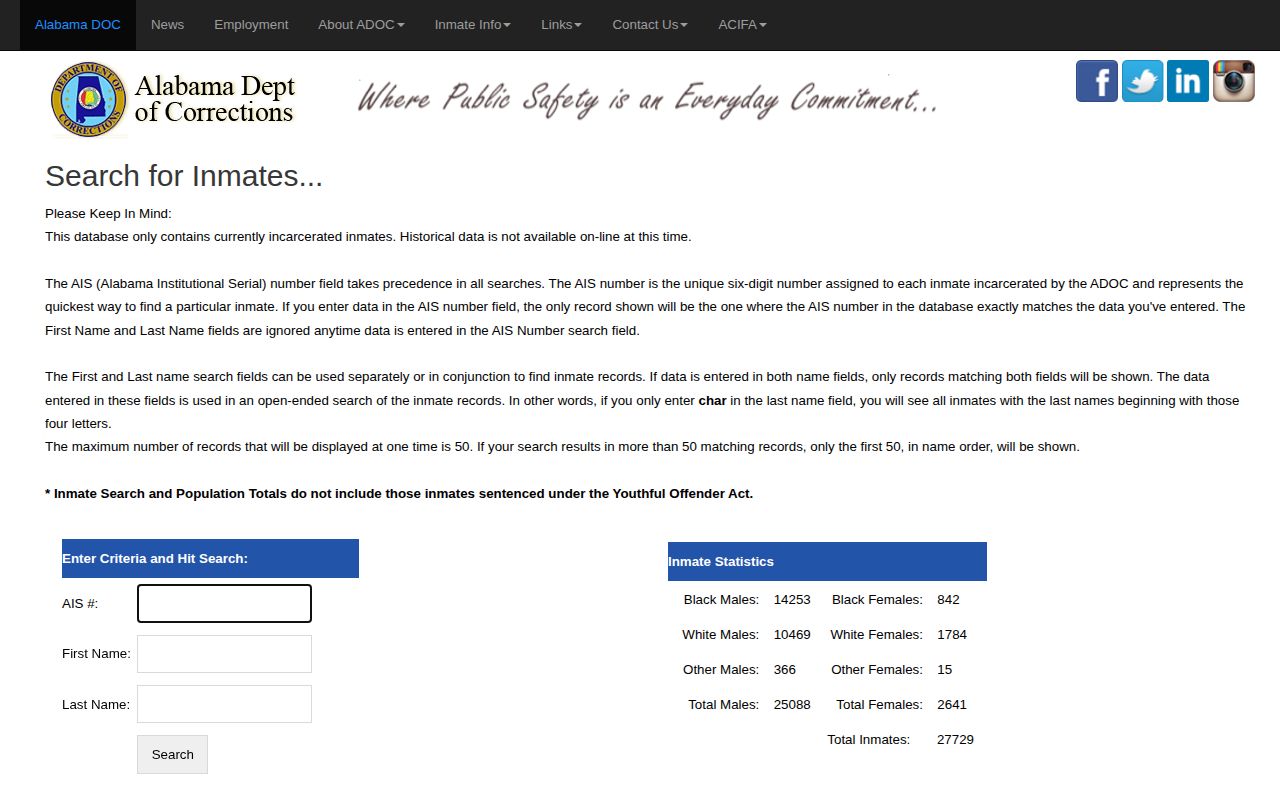
The image supports the main limitation of this path: ADOC search is a current-prison tool, not a county jail release archive.
ADOC Release-Date Fields
ADOC's definitions page explains the fields that matter while a person is still incarcerated. "Minimum Release Date" is the earliest scheduled date an inmate can be released to probation or end of sentence. ADOC says this date can change if the inmate receives disciplinary action that takes away good time or if the circuit clerk sends new cases or changes the sentence. For a Chambers County sentence, that ties the state-prison calculation back to the Chambers County court and clerk record.
| Field | Why it matters |
|---|---|
| Minimum Release Date | Earliest scheduled release to probation or end of sentence; not a guaranteed door date |
| Jail Credit | Credit for time already served before ADOC commitment |
| Good Time Received / Revoked | Correctional Incentive Time that can shorten or lengthen the calculated date |
| Parole Consideration Date | Date when the Parole Board may consider release; not the same as release |
| Parole Status | Current parole-related status as defined by ADOC and ABPP processes |
Alabama Code section 14-9-41 governs Correctional Incentive Time and includes categories that may be excluded from earning it, such as certain Class A felony, life, death, longer sentence, death-by-deadly-weapon, and child sex offense situations. Alabama Code section 15-22-26.2 creates mandatory supervision for eligible ADOC inmates near the end of sentence. ABPP describes mandatory release as an automated process for qualifying inmates whose offenses occurred on or after January 30, 2016, with exclusions such as child sex offenders and life sentences.
Parole, Mandatory Supervision, and Court Records
Parole and mandatory supervision are not the same as a completed sentence with no supervision. ABPP's public site posts scheduled parole hearings, parole results, and hearing minutes. Those records can show a Board action such as grant, denial, continuance, deferment, or other action shown in the posted documents. A grant does not always mean immediate physical release. Conditions, address approval, victim notification, detainers, processing, or disciplinary issues can affect timing.
The LaFayette ABPP Field Office serves Chambers County supervision matters from 115 1st Street SE. Use that local office when the question is whether someone released from ADOC is on parole, probation, or mandatory supervision in the community. Use Chambers County court records when the issue is the sentence itself, jail credit, probation terms, revocation filings, warrants, or later discharge by court order.
ABPP records are most useful when the release question involves a Board decision or supervision status. Scheduled hearing lists show upcoming parole consideration. Parole results and hearing minutes can show what the Board did in a particular month. They do not replace ADOC's custody record or the sentencing court's order. A person can have a parole consideration date and remain in prison, and a person can leave prison under mandatory supervision without an ordinary discretionary parole grant. Keep those categories separate when reading a Chambers County state sentence.
Limits on Public ADOC Records
ADOC excludes people sentenced under Alabama's Youthful Offender Act from the public inmate search. Juvenile, Youthful Offender, sealed, expunged, and confidential records are access boundaries, not missing-data accidents. If an ADOC search does not show a person, avoid broad conclusions until you have checked the sentencing court, ADOC records, ABPP, Alabama VNS, and any applicable registry or receiving-agency path.
Those limits also affect how a state-prison release should be described. A public page can explain the route to official records, but it should not promise that every sentence, photo, discharge record, or supervision detail is publicly available online. If an expungement, sealing order, juvenile status, Youthful Offender status, victim protection rule, or agency-specific rule applies, the public record may be narrowed or withheld. A careful request should ask for the exact releasable record needed, such as the ADOC release date, discharge status, transfer history, or supervision handoff.
The Chambers County Detention Facility page should be used for local jail custody and release records. This ADOC page should be used only when the case moved into state-prison custody or state-prison supervision. When both systems appear in one record trail, read the county jail entry as the custody handoff and the ADOC record as the prison-release source.